Cartier’s dials read “Swiss Made,” but in 2025 the U.S. government made sure nobody could ignore where those watches came from. As part of the Swiss-based Richemont group, Cartier suddenly found itself in the crosshairs of new U.S. tariffs—and the secondary market reacted in a way that every collector should pay attention to.
Tariffs, price hikes, and Cartier
Cartier sits under Richemont, the Swiss luxury conglomerate that also owns brands like IWC, Panerai, and Vacheron Constantin, which means Cartier gets treated as Swiss in trade policy even though its aesthetic often leans French. In 2025, the U.S. imposed a 15% tariff on a broad range of EU imports and a much steeper 31% tariff on Swiss goods, instantly reshaping the cost structure for many luxury watches in the American market. These measures translated into roughly 10–15% price hikes for Cartier pieces at U.S. retail, pushing many buyers to rethink when and where they were willing to spend on a Tank, Santos, or Ballon Bleu.
First shock: sales slide after tariffs
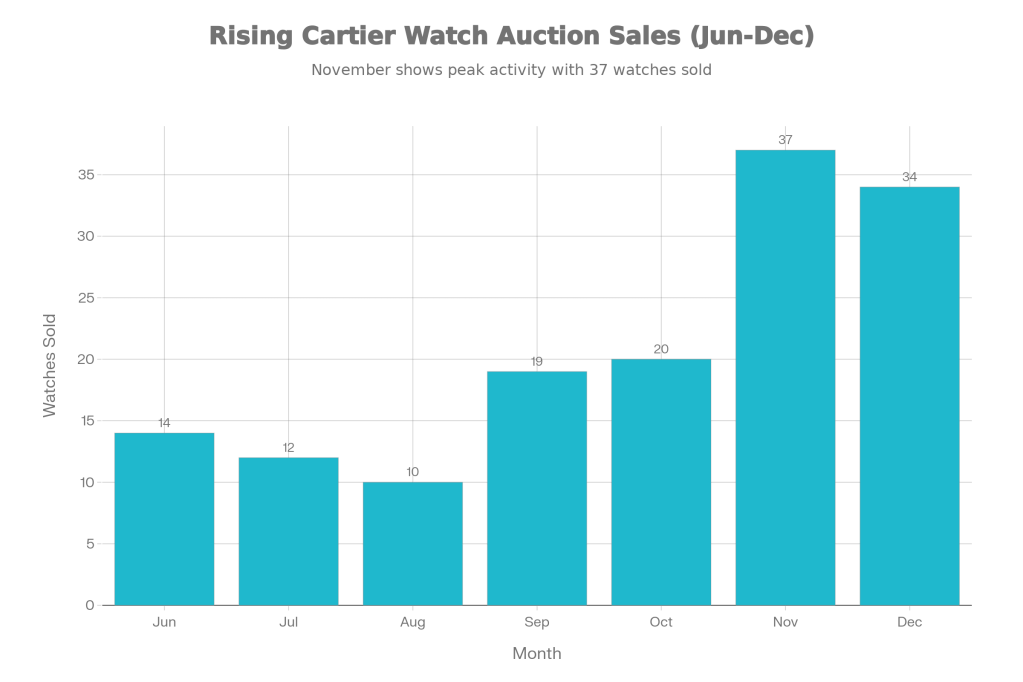
To understand how this played out in the real world, a look at secondary-market auction data is revealing. In June, completed Cartier watch sales on one auction site came in at 14 pieces, followed by a small dip to 12 in July—normal month-to-month noise in a niche but healthy market. Once the new tariffs hit, however, August sales slid to 10 watches, suggesting an immediate hesitation from buyers who needed time to digest higher prices and recalibrate what “fair value” meant in a new, more expensive environment.
Pent‑up demand starts to build
That pause did not last long. By September, the same auction data shows sales jumping to 19 Cartier watches, with October edging even higher at 20. In just two months, the market more than doubled from its August low, signaling that collectors and enthusiasts had decided Cartier was still worth pursuing—tariffs or not. Rather than killing demand, the new price reality appears to have pushed more buyers into the secondary market, where they could hunt for value, negotiate, and arbitrage price differences between regions and platforms.
Year‑end surge: Cartier catches fire
As the year drew to a close, the story became even more dramatic. With gold prices surging and the broader watch market buzzing around hard-asset luxury, November posted 37 completed Cartier watch sales on the auction site, and December followed with 34. Those numbers represent not just healthy demand but a full-on Cartier moment, with volume more than tripling from the August trough. The combination of higher retail prices, strong brand desirability, and macro narratives around gold and tangible assets created the perfect environment for Cartier to shine in the secondary market.
What this means for collectors and investors
The pattern is unmistakable: tariffs triggered a short-term wobble, then helped fuel a powerful rally in secondary-market Cartier sales. For collectors, this underscores a few key lessons: moments of policy-driven uncertainty can create brief buying windows before the crowd rushes in, and beloved heritage brands like Cartier often emerge stronger when scarcity and higher retail prices reframe them as even more aspirational.
For investors and flippers, the data shows that when a brand has genuine cultural momentum, external shocks like tariffs don’t crush demand—they concentrate it where the most motivated buyers are willing to meet the market.
What brand will you be buying?
 Home
Home 
Leave a comment